Nasya
Nasya Karma is a key Ayurvedic therapy. It uses the nose to put medicine in the body. This helps fix problems above the collarbone (Urdhvajatru). Nasya can cleanse deeply or calm locally, based on the medicine used. It helps protect the nose and affects the brain, sinuses, and senses. Nasya comes from the Sanskrit word Nasa (नास) or Nasika (नासिका), which means "nose." Nasya means "good for the nose" (Nāṣāyāṃ bhavaṃ nasyam). Old texts say it's a nose treatment for body or local health issues.

What is Nasya?
Nasya Karma stands as one of the most vital therapeutic modalities within the Panchakarma (five-fold bio-purificatory) framework of Ayurveda. Defined as the administration of medicated substances through the nasal passages, Nasya is uniquely designated to treat disorders originating above the clavicle (Urdhvajatru). Within Ayurvedic therapeutics, it spans both Shodhana (purification to eliminate deep-seated morbid Doshas) and Shamana (palliation to pacify localized imbalances) depending on the medium and dosage utilized. Operating at the intersection of local mucosal protection and systemic neuro-endocrine modulation, Nasya provides a direct, non-invasive therapeutic conduit to the central nervous system, paranasal sinuses, and sensory organs.
Key Health Benefits
I. Urdhvajatrugata Prasada/Clear Sinuses (ENT & Head Health)
- Fixes: Ear, nose, and throat problems. Oils block germs and help nose health.
- Sanskrit Terminology: Urdhvajatru-prasādana (rejuvenation of supraclavicular organs).
- Mechanism: Nasya clears anatomical obstructions within the ear, nose, throat, and head. Medicated lipid formulations act as physical barriers against airborne pathogens and particulate matter, stabilizing mucosal immunity and promoting upper respiratory wellness.
II. Shiro-Roga Shamana/Stop Headaches (Relief of Headaches & Sinusitis)
- Fixes: Herbs in oils cut pain in the sinuses.
- Sanskrit Terminology: Shiro-śūla-hara (analgesic of the cranial region).
- Mechanism: Active herbal ingredients (such as Eranda or Rasna present in Anu Taila) reduce inflammatory prostaglandins within the paranasal sinuses. This action alleviates pressure-induced discomfort, relieves localized tension, and promotes drainage of trapped mucus.
III. Manasika Prasada/Boost Brain (Cognitive Clarity & Tension Relief)
- Fixes: Warm oil calms nerves and clears the mind.
- Sanskrit Terminology: Medhya (nootropic) & Citta-prasādana (mental calming).
- Mechanism: Warm oil administration stimulates the sensory nerve endings of the olfactory tract, which project directly to the amygdala and hippocampus (limbic system). This interaction balances neurochemistry, relieves emotional tension, and enhances mental clarity.
IV. Indriya-Prasada/Boost Senses (Sensory Rejuvenation)
- Fixes: Helps blood flow and nerve health, keeping senses sharp.
- Sanskrit Terminology: Indriya-balaprada (strengthener of sensory faculties).
- Mechanism: By nourishing the cerebral blood flow and lubricating cranial nerve pathways, Nasya prevents premature degeneration of the optical, auditory, and olfactory faculties [1].
How it Works (Procedure Steps)
Purva Karma (Pre-Procedure)
- Patient Preparation: Ensure the patient is in an optimal physiological state: empty stomach, empty bladder, and evacuated bowels.
- Snehana (Oleation): A gentle facial and neck massage (Mukha Abhyanga) is performed using warm oil (such as Ksheerabala Taila or Tila Taila) for 5–10 minutes, focusing on sinus areas (frontal, maxillary, ethmoidal).
- Svedana (Sudation): Mild localized steam inhalation (Nadi Sveda) is applied to the face and neck while covering the eyes with damp cotton pads. This step liquefies (Vilayana) stagnant Doshas within the sinuses.
Pradhana Karma (Main Procedure)
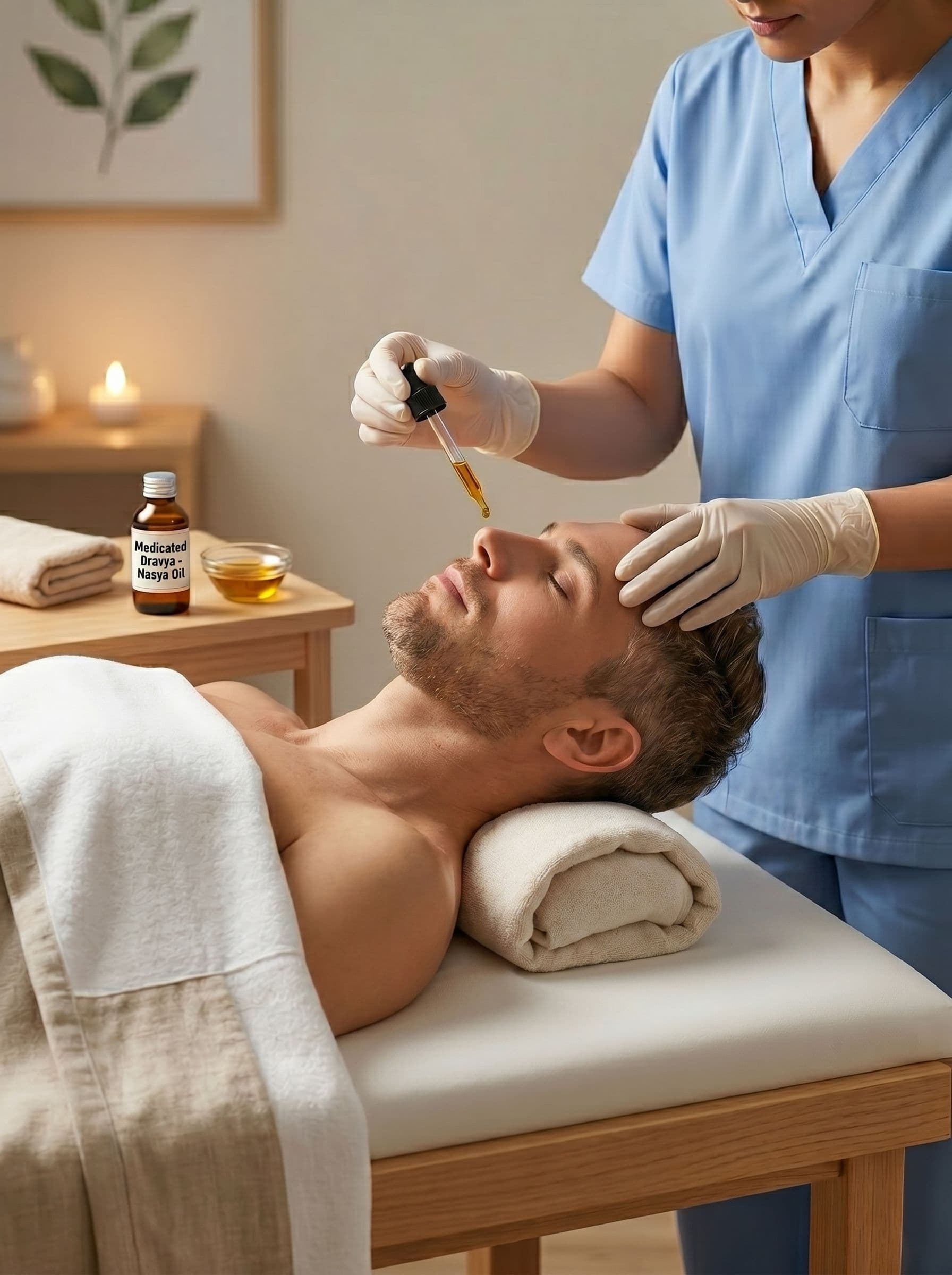
- Positioning: The patient lies supine (Uttana) on a comfortable table, with the head slightly lowered (Shiro-Avanata) by placing a pillow beneath the neck.
- Temperature of Dravya: The selected medicated oil is warmed indirectly in a warm water bath to body temperature (approximately $37^\circ\text{C} - 38^\circ\text{C}$).
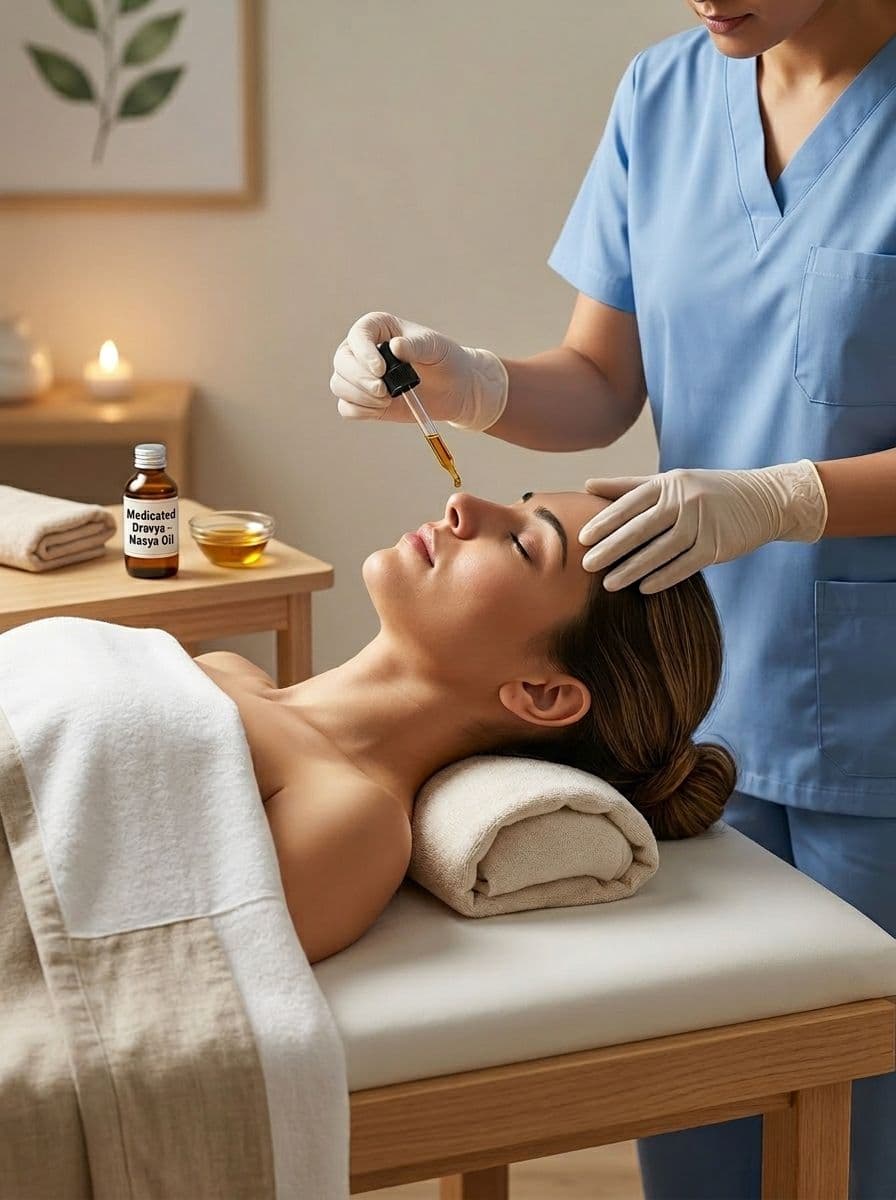
- Administration: The therapist raises the tip of the patient's nose with the left thumb and carefully instills the prescribed dosage (commonly 4 to 8 drops for therapeutic Marsha Nasya) into each nostril alternately.
- Respiration and Absorption: The patient is instructed to inhale deeply yet gently to draw the medicine upward. The palms, soles, shoulders, and neck are gently massaged during this process to encourage systemic distribution.
Paschat Karma (Post-Procedure)
- Expulsion of Secretions: The patient is instructed to spit out any oil or mucus that reaches the throat (Kanta-gata Kapha). Swallowing these secretions is strictly contraindicated to prevent secondary gastrointestinal or pulmonary congestion.
- Kavala (Gargling): The oral cavity is rinsed with warm saline water or a warm herbal decoction to clear residual secretions.
- Dhumapana (Inhalation of Medicated Smoke): Herbal smoking (Dhumapana) may be administered to clear remaining Kapha.
- Parihara Vishaya (Do's and Don'ts): The patient must rest for 15–20 minutes and avoid exposure to drafts, cold wind, immediate intake of cold fluids, bathing, or sleeping immediately after the procedure.
Best Suited For
Nasya Karma is indicated for a wide variety of conditions, categorized below:
Specific Clinical Conditions
- Respiratory & Sinus: Chronic sinusitis (Pratishyaya), allergic rhinitis, nasal polyps, and deviations.
- Neurological & Musculoskeletal: Migraine (Ardhavabhedaka), tension headaches (Shirashoola), facial paralysis (Ardita), trigeminal neuralgia, cervical spondylosis (Greeva Stambha), and frozen shoulder (Apabahuka).
- Sensory Deficits: Premature graying of hair (Palitya), alopecia (Khalitya), optic atrophy, and tinnitus.
Constitutional Types (Prakriti)
- Vata Prakriti: Benefits from nourishing (Brimhana) Nasya utilizing medicated ghee or sweet, warm oils to counteract dryness and neurological hypersensitivity.
- Kapha Prakriti: Benefits from purifying (Shodhana/Tikshna) Nasya using pungent herbs to clear heavy, stagnant congestion.
Lifestyle & Modern Stressors
- For professionals experiencing chronic mental fatigue, high screen time, or structural strain in the neck and shoulders [4].
- Residents of metropolitan areas exposed to industrial pollutants and dry air.
Avoid If (Contraindications)
Nasya should be avoided under the following clinical circumstances:
- Acute Illness: Acute fever (Nava Jvara), acute indigestion, or immediate ingestion of alcohol or heavy meals.
- Physiological States: Pregnancy (Garbhini), immediate postpartum state, and during active menstruation.
- Age Limits: Contraindicated in children under 7 years of age and elderly patients over 80 years of age (except for gentle, low-dose Pratimarsha Nasya).
⚠️ Medical Disclaimer
Nasya Karma is a highly potent therapeutic procedure that must be tailored to individual pathodynamics. It should be undertaken only after a comprehensive assessment by a BAMS-certified Ayurvedic physician (Vaidya).
Ayurvedic Physiology (The "Deep Dive")
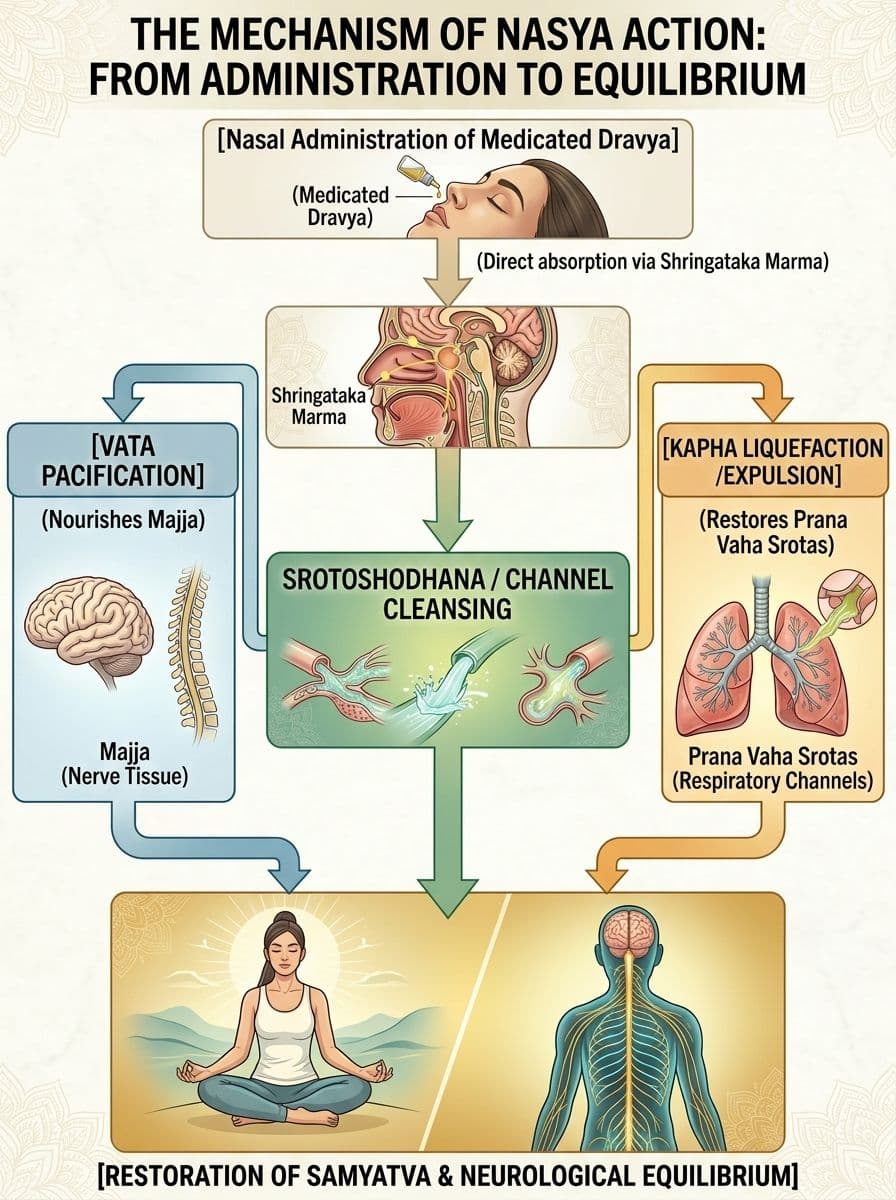
According to Ayurvedic pathophysiology, the cranial region (Shiras) is the seat of the Prana Vayu (the sub-dosha of Vata governing neurological impulses), Sadhaka Pitta (governing cognitive processing), and Tarpanaka Kapha (responsible for lubricating and cushioning sensory-neural tissues).
When morbid Doshas (primarily Vata and Kapha) accumulate in the supraclavicular channels (Srotas), they obstruct the flow of Prana, manifesting as neurological disorders, headaches, and sensory deficits.
Nasya targets the Shringataka Marma—a vital anatomical confluence of the channels supplying the nose, eyes, ears, and tongue. The active principles of the nasal instillations reach this vital point and diffuse throughout the head. This process facilitates Srotoshodhana (cleansing of channels) and Samprapti Vighatana (breaking the pathogenesis of Urdhvajatrugata diseases) by expelling stagnant Kapha and pacifying hyperactive Vata.
Modern Physiological Mechanism
From a modern medical standpoint, the efficacy of Nasya can be explained through three primary pathways:
Direct Olfactory and Trigeminal Pathway (Blood-Brain Barrier Bypass):
Medicated oils bypass the blood-brain barrier (BBB) via the olfactory nerve (CN I) and trigeminal nerve (CN V) pathways. Lipophilic active constituents travel along the perineural spaces directly into the cerebrospinal fluid (CSF) and brain parenchyma.
Kiesselbach’s Plexus & Vascular Absorption:
The nasal mucosa is highly vascularized. Medicated substances are rapidly absorbed into the systemic circulation via the venous plexus, avoiding first-pass hepatic metabolism.
Neuro-Endocrine-Immune Modulation:
The warm, medicated lipid vehicle stimulates local mucosal mechanoreceptors and thermoreceptors. This stimulation modulates the Hypothalamo-Pituitary-Adrenal (HPA) axis, promoting neurological relaxation, relieving systemic tension, and regulating cytokine-mediated inflammatory pathways.
Dravya Category
Siddha Taila (Medicated Oils): Anu Taila, Shadbindu Taila
Siddha Ghrita (Medicated Ghee): Saraswata Ghrita, Brahmi Ghrita
Svarasa / Kwatha (Juices / Decoctions):Tulasi Svarasa, Shunthi Kwatha
Conclusion
Nasya is an old Ayurvedic method to clear sinuses and boost brain health. It uses the nose to reach the brain and clear blocks. It helps with sinus problems, headaches, and nerve issues. Whether used daily or for deep cleaning, Nasya helps keep the head clear and balanced.
Frequently Asked Questions
Can Nasya be performed during menstruation?▼
Strong, therapeutic purification doses (Marsha Nasya) are generally contraindicated during menstruation because the body's natural downward flow of energy (Apana Vayu) can be disrupted by the upward-moving action of Nasya. However, a gentle, daily maintenance dose (Pratimarsha Nasya, 1–2 drops) is typically safe to administer.
How does Nasya help with sinus congestion?▼
Nasya utilizes warm, lipophilic medicated oils that penetrate the sinus mucosal tissue. The warmth liquefies stagnant mucus, while the active herbal ingredients help reduce inflammation in the mucosal linings, supporting natural ciliary clearance and drainage.
What is the ideal time of day to perform Nasya?▼
The ideal timing depends on the presenting Dosha imbalance:
- Kapha disorders: Morning (to counteract the natural diurnal peak of Kapha).
- Pitta disorders: Mid-day (when Pitta is dominant).
- Vata disorders: Late afternoon or evening (when Vata is dominant).
How many drops of oil should be administered?▼
The dosage depends on the type of Nasya:
- Pratimarsha Nasya (Daily preventive): 1 to 2 drops in each nostril daily.
- Marsha Nasya (Therapeutic): 4 to 8 drops (or more, under strict clinical supervision) per nostril, depending on the patient's strength and the severity of the condition.
Is it normal to feel a burning sensation in the throat during Nasya?▼
Yes, a mild burn is common with strong oils. It goes away after spitting out mucus and gargling. Especially when using Tikshna (pungent and penetrating) oils like Anu Taila or Shadbindu Taila.
References
- Nasya – The Powerful Nasal Therapy of Ayurveda.
- Therapeutic Significance of Nasya Karma in Panchakarma: A Holistic Approach.
- Nasal Instillation (Nasiyam) as an External Therapy for Cranio-Facial Conditions.
- How to Do Nasya Oil for Nasal Health and Wellness.
- Nasya Therapy for Sinus & Respiratory Health. Yukti Herbs.
Medical Reviewer

Syed Aman Hussain
BAMS, MD
Dr. Syed Aman Hussain is a dedicated Ayurvedic physician specializing in the ancient science of detoxification and rejuvenation. An alumnus of the highly esteemed Ayurvedic and Unani Tibbia College, Government of NCT of Delhi, he holds a degree in Bachelor of Ayurvedic Medicine and Surgery (BAMS).