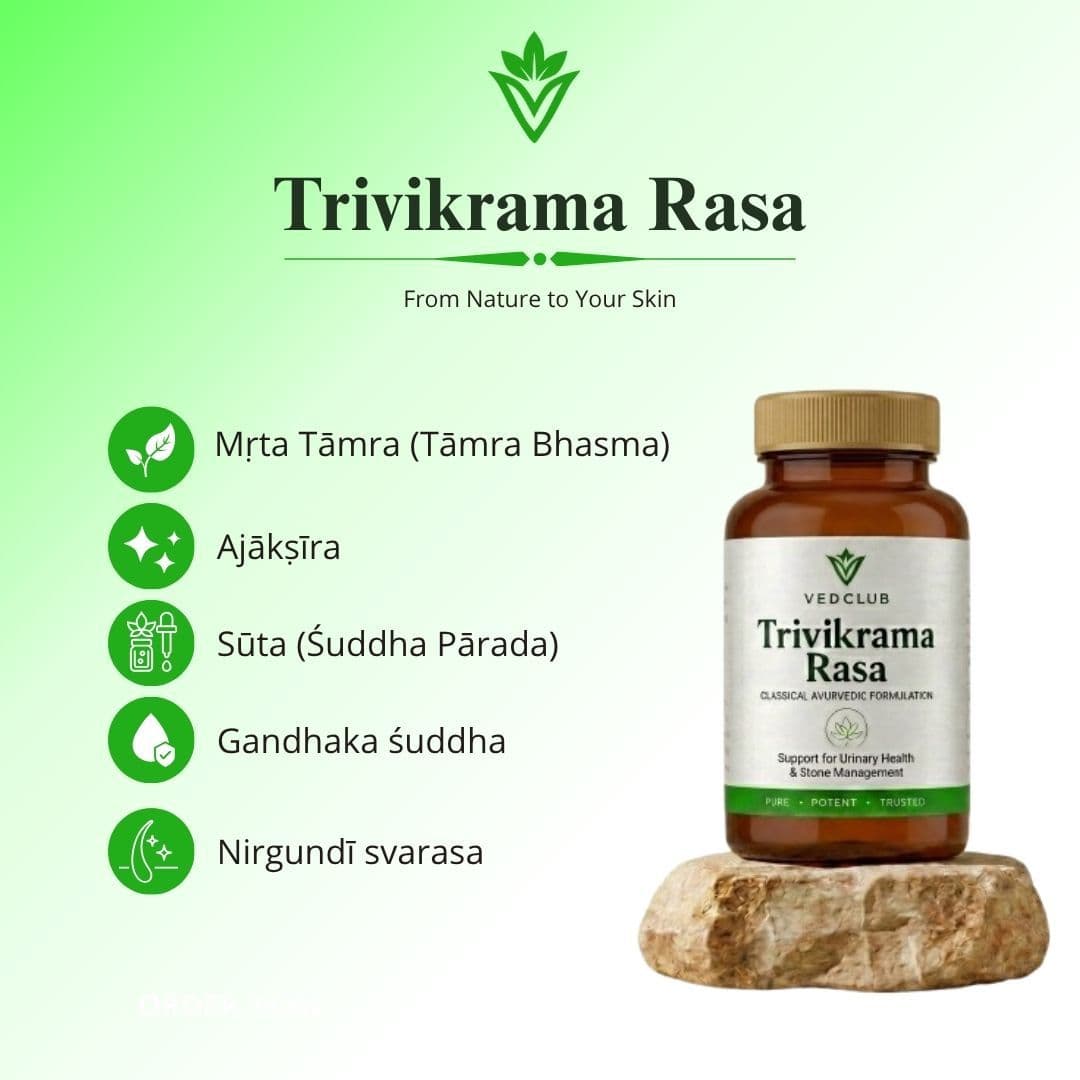

Trivikrama Rasa for Urinary Stones (Aśmārī) and UTI: Ayurvedic Approach and Science
Ayurvedic Understanding of Aśmārī
In Ayurveda, Aśmārī (urinary calculi) is understood as a condition resulting from imbalances among the Vata, Pitta, and Kapha doshas, leading to the crystallization of waste products within the urinary tract. Trivikrama Rasa addresses this condition through a multi-faceted approach.
- Litholytic Action: Tāmra Bhasma is traditionally believed to break down calculi, while the overall preparation supports the elimination of gravel and smaller stones from the urinary passages.
- Vata-Pitta Balance: By balancing Vata and Pitta, the formulation addresses underlying metabolic disturbances that contribute to stone formation and associated symptoms such as burning urination and pain.
- Urinary Tract Health: Its therapeutic scope extends to UTIs and bladder stones. The combination of purified minerals and Nirgundī works synergistically to relieve discomfort and promote healing in the urinary tract.
Classical Reference
"रसस्त्रिविक्रमो नाम्ना मासैकेनाशमरीप्रणुत् |" Rasastrivikramo nāmnā māsaikena śmarī praṇut |
This shloka states that Trivikrama Rasa, by its very name, can eliminate Aśmārī (stones) within one month — highlighting its specific and powerful action against urinary calculi.
Method of Preparation
The preparation of Trivikrama Rasa is a meticulous process as described in the classical text:
"मृतं ताम्रमजाक्षीरेः पाच्यं तुल्यैर्गतद्रवम् | तत् ताम्रं शुद्धसूतं च गन्धकं च समं समम् | निर्गुण्डीस्वरसैर्मर्थं तद्गोलं सन्धयेद् दिनम् | यामैकं बालुकायन्त्रे पाच्यं योज्यं द्विगुञ्जकम् |"
- Purified Tāmra Bhasma is first boiled with an equal quantity of goat's milk until the milk fully evaporates.
- Purified mercury (Sūta) and purified sulfur (Gandhaka) are then added to the processed Tāmra.
- All ingredients are triturated (mardana) with fresh Nirgundī leaf juice to form a coherent mass.
- This mass is placed in a Vālukā Yantra (sand bath apparatus) and subjected to heat for approximately three hours.
- After natural cooling, the preparation is removed and finely ground for use.
Trivikrama Rasa: Role of Each Ingredient and Its Therapeutic Action
- Mṛta Tāmra (Tāmra Bhasma): Possesses potent litholytic (stone-dissolving) and diuretic properties; used in conditions involving calculi, inflammation, and metabolic imbalances.
- Ajākṣīra (Goat's Milk): Serves as the processing medium (Dravya Saṃskāra); cooling, nourishing, and easily digestible; mitigates the intensity of minerals and enhances their therapeutic effects; known for immunomodulatory and anti-inflammatory benefits.
- Sūta (Śuddha Pārada / Purified Mercury): Principal mineral and vital component; after rigorous purification (śodhana), acts as a yogavāhi, enhancing the bioavailability and efficacy of all other ingredients.
- Gandhaka Śuddha (Purified Sulfur): Combined with purified mercury to form Kajjalī, the foundation of Rasa preparations; known for detoxifying, rejuvenating (rasāyana), and antimicrobial properties.
- Nirgundī Svarasa (Vitex negundo leaf juice): Processing medium (Bhāvanā Dravya); used for trituration (mardana) to enhance potency and therapeutic absorption; analgesic, anti-inflammatory, and antipyretic in action.
Other Potential Benefits
- Energy and Stamina: May help improve stamina and energy levels, potentially by supporting haemoglobin and neural tissues.
- Immunomodulatory and Anti-inflammatory Effects: The inclusion of goat's milk as a processing agent contributes to the potential immunomodulatory and anti-inflammatory effects of the formulation. These benefits require further scientific validation.