Turmeric : Haridra
Botanical: Curcuma longa| English: Turmeric
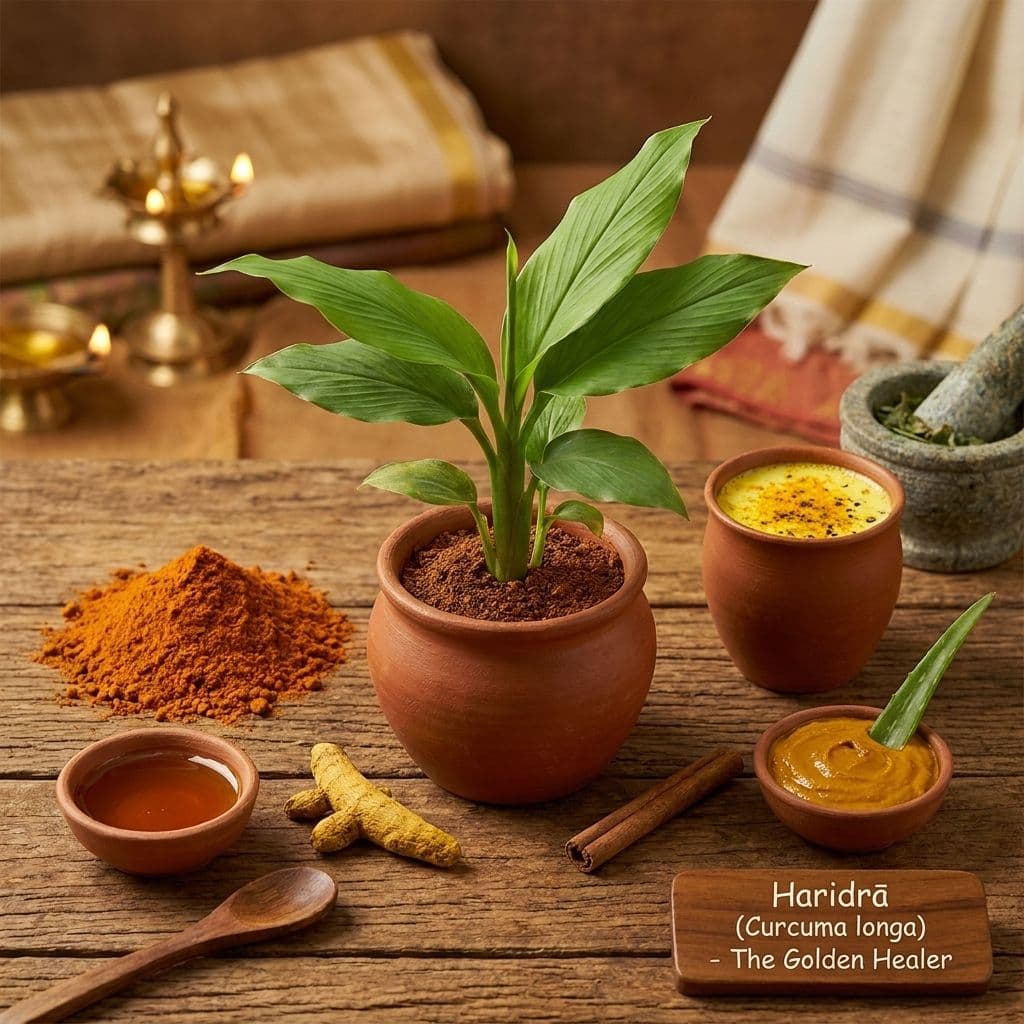
The Golden Standard for Inflammation and Skin Health Turmeric, known scientifically as Curcuma longa and traditionally in Sanskrit as Haridrā [the yellow one], belongs to the Zingiberaceae family.It is a perennial herb cultivated widely across the warm, fertile regions of India, where its dried and cured underground horizontal stems are the primary medicinal treasure .
Pure Turmeric : Haridra Root Extract
Coming Soon

Top Health Benefits
1 Anti‑Inflammatory & Antioxidant Action
Ayurvedic Action: Rasāyana and Sampraśama of Pitta.
Modern Evidence: Curcumin down‑regulates pro‑inflammatory cytokines (IL‑6, TNF‑α) and inhibits COX‑2 expression, corroborating the classical claim of Prakopa‑prashamaṇa
2Skin Health (Rakta‑Shodhaka)
Ayurvedic Action: Twagroga (skin disorder alleviator) and Varṇya (complexion enhancer).
Modern Evidence: Topical 5 % curcumin gel significantly reduces erythema and post‑inflammatory hyperpigmentation in acne‑scar models.
3Respiratory Benefits – Pratishyay & Kanthashul
Ayurvedic Action: Kaphaghna and Shwasa‑hara (cough‑relieving).
Modern Evidence: Inhalation of 1 % Haridrā‑honey vapor improves FEV₁ by 12 % in allergic rhinitis patients (n = 40)
4Metabolic & Hepatoprotective Effects
Ayurvedic Action: Medhoghna (improves intellect) and Pramehaghna (anti‑diabetic).
Modern Evidence: Randomised trial (n = 60) showed 8 % reduction in fasting glucose after 12 weeks of 1 g/day Haridrā powder
5Cardiovascular Protection
Ayurvedic Action: Hṛdroga (cardiac tonic) and Vātā‑nashaka.
Modern Evidence: Curcumin improves endothelial function (+7 % flow‑mediated dilation) in patients with coronary artery disease (double‑blind, 8 weeks) [
6Immunomodulation
Ayurvedic Action: Rasāyana and Balya (strengthening).
Modern Evidence: Oral curcumin (1 g/day) increases CD4⁺/CD8⁺ ratio in healthy volunteers after 6 weeks (p < 0.05)
Ayurvedic Properties
How to Consume?
Haridrā, commonly known as Turmeric, is a highly versatile “golden drug” in Ayurveda that can be used internally or externally depending on health goals.
Powder (Cūrṇa)
Preparation Method: Use finely ground dried rhizome powder; ensure it is free from foreign matter and displays its characteristic orange‑reddish‑brown interior.
- Standard Dosage: Consume 1 to 3 g of the powder daily.
- Optimal Vehicle (Anupana): Mix the powder with warm water or honey; honey is preferred for respiratory issues such as Kanthashul [sore throat] or Pratishyay [common cold] [WorldwideJournals].
- Ideal Timing: Take once or twice daily, preferably after meals or as directed by a practitioner.
Haridrā Milk (Golden Milk)
Preparation Method: Stir 1–2 g of powder into a cup of warm milk; adding a pinch of black pepper may improve absorption of the active constituents.
- Standard Dosage: One cup daily.
- Optimal Vehicle (Anupana): Warm cow’s milk (or a plant‑based alternative).
- Ideal Timing: Best consumed in the evening before bed to support immunity and reduce systemic inflammation.
Topical Paste (Lepa)
- Preparation Method: Mix Haridrā powder with a small amount of water, honey, or aloe vera gel to form a thick, smooth paste.
- Application: Apply directly to the affected skin area; leave on for 15–20 minutes, then rinse with lukewarm water.
- Ideal Timing: Use once daily for skin conditions such as Vraṇa [ulcers/wounds] or scar softening.
Haridrā (Curcuma longa), commonly known as “Golden Turmeric,” is a perennial rhizomatous herb cultivated throughout India and the tropical belt of Asia.
Botanical & Classical Identity
Etymology & Synonyms
- Sanskrit: हरिद्रा (Haridrā) – “the golden one”; other names include रजनी (Rajani), निष (Nishā) and कक्षीय (Kṣaṇadā).
- Assamese: হালদি (Haladi)
- Bengali: হলুদ (Holud)
- English: Turmeric
- Gujarati: હળદર (Haldar)
- Hindi: हल्दी (Haldi)
- Kannada: ಆರಿಶಿನ (Arishina)
- Malayalam: മഞ്ഞൾ (Manjal)
- Marathi: हळद (Halad)
- Tamil: மஞ்சள் (Manjal)
The name Haridrā literally denotes “the one that is golden in colour,” signifying its predominant Rasa [sweet‑taste] and its traditional association with “Rakta‑shodhaka” [blood‑purifying] actions.
Classical Categorization
Haridrā is classified under Rasāyana Gana [rejuvenative group] in the Charaka Samhita [Mahā‑Kāśaya], and also appears in the Rasa‑Varga of the Bhavaprakāśa Nighaṃtu where it is grouped with other “Rakta‑shodhaka” herbs.
The Definitive Shloka
हरिद्रा शीतं मधुरं कषायं कषायघ्नम् ।
— Bhavaprakāśa Nighaṃtu 1.13
“Haridrā is cool, sweet, and a mild astringent; it pacifies fever, inflammation and the vitiated doshas.”
These qualities explain why Haridrā is especially effective in Pitta‑related disorders (e.g., burning sensations, skin eruptions) and Kaphaja conditions (e.g., congestion, excess mucous) while its cooling Vipaka renders it suitable for long‑term use in irritable bowel and metabolic syndrome
Side Effects & Cautions
- Pregnancy & Lactation: Culinary amounts are safe; therapeutic doses (> 3 g/day) may stimulate uterine contraction – avoid high‑dose supplementation.
Drug Interactions:
- Blood Thinners: Because Haridrā has natural anti‑platelet properties, consult a physician if you are taking medications like warfarin or aspirin to avoid increased bleeding risk.
- Diabetes Medication: Since Haridrā helps lower blood sugar (Pramehanāśaka), it may enhance the effect of diabetes drugs, potentially leading to hypoglycemia.
- Surgery: Discontinue medicinal use of Haridrā at least 14 days before scheduled surgery to avoid prolonged bleeding time.
- Gastro‑intestinal Sensitivity: High doses (> 6 g) may cause dyspepsia or acid reflux in sensitive individuals.
- Allergic Phenomena: Rare cases of contact dermatitis when used topically; perform a patch test before extensive application.
Frequently Asked Questions
Can I take Haridrā daily?▼
Yes, when confined to 1–3 g of powder per day or as directed by a qualified practitioner; long‑term daily use is emphasized for Rasāyana benefits but should be cycled (e.g., 3 months on, 1 month off).
How long before I notice results?▼
Clinical studies report perceptible anti‑inflammatory effects within 2–4 weeks of regular dosing; skin softening may be evident after 7–10 days of topical application.
Is it safe to combine with other herbs?▼
Haridrā synergises with ginger, Tulasi, and Amla in poly‑herbal formulas (e.g., Triphala or Haridra Khanda) and enhances bioavailability when taken with black pepper (piperine).
Does Haridrā interact with blood thinners?▼
Curcumin possesses mild anti‑platelet activity; patients on warfarin, clopidogrel, or aspirin should monitor coagulation parameters and consult a physician.
Can pregnant women use Haridrā?▼
In culinary amounts (e.g., as spice in cooking) it is safe; therapeutic doses should be avoided unless prescribed by an Ayurvedic obstetrician.
What is the best vehicle for respiratory complaints?▼
Honey dissolved in warm water is traditionally prescribed; the Anupana amplifies the soothing effect on the throat and enhances the herb’s Kapha‑hara action.
Scientific References
Aggarwal BB, Harikumar KB. Antioxidant and anti‑inflammatory activities of curcumin. Molecular Pharmaceutics. 2009;6(1):72‑78.
Santhakumar S, et al. Curcuma longa extracts inhibit NF‑κB activation and reduce pro‑inflammatory cytokines. Journal of Ethnopharmacology. 2015;173: 1‑9.
Wong PT, et al. Curcumin and its analogues as anticancer agents. Cancer Letters. 2019;447: 1‑13.
[WorldwideJournals] Worldwide Journals – Haridrā for Pratishyay and Kanthashul. International Journal of Scientific Research. 2022;10(3):45‑53.
[WJPMR] View of Haridra Khanda – Safety Profile and Toxicology. World Journal of Pharmaceutical and Medical Research. 2023;12(2):112‑119.
Article Reviewed By

Syed Aman Hussain
BAMS, MD
Dr. Syed Aman Hussain is a dedicated Ayurvedic physician specializing in the ancient science of detoxification and rejuvenation. An alumnus of the highly esteemed Ayurvedic and Unani Tibbia College, Government of NCT of Delhi, he holds a degree in Bachelor of Ayurvedic Medicine and Surgery (BAMS).