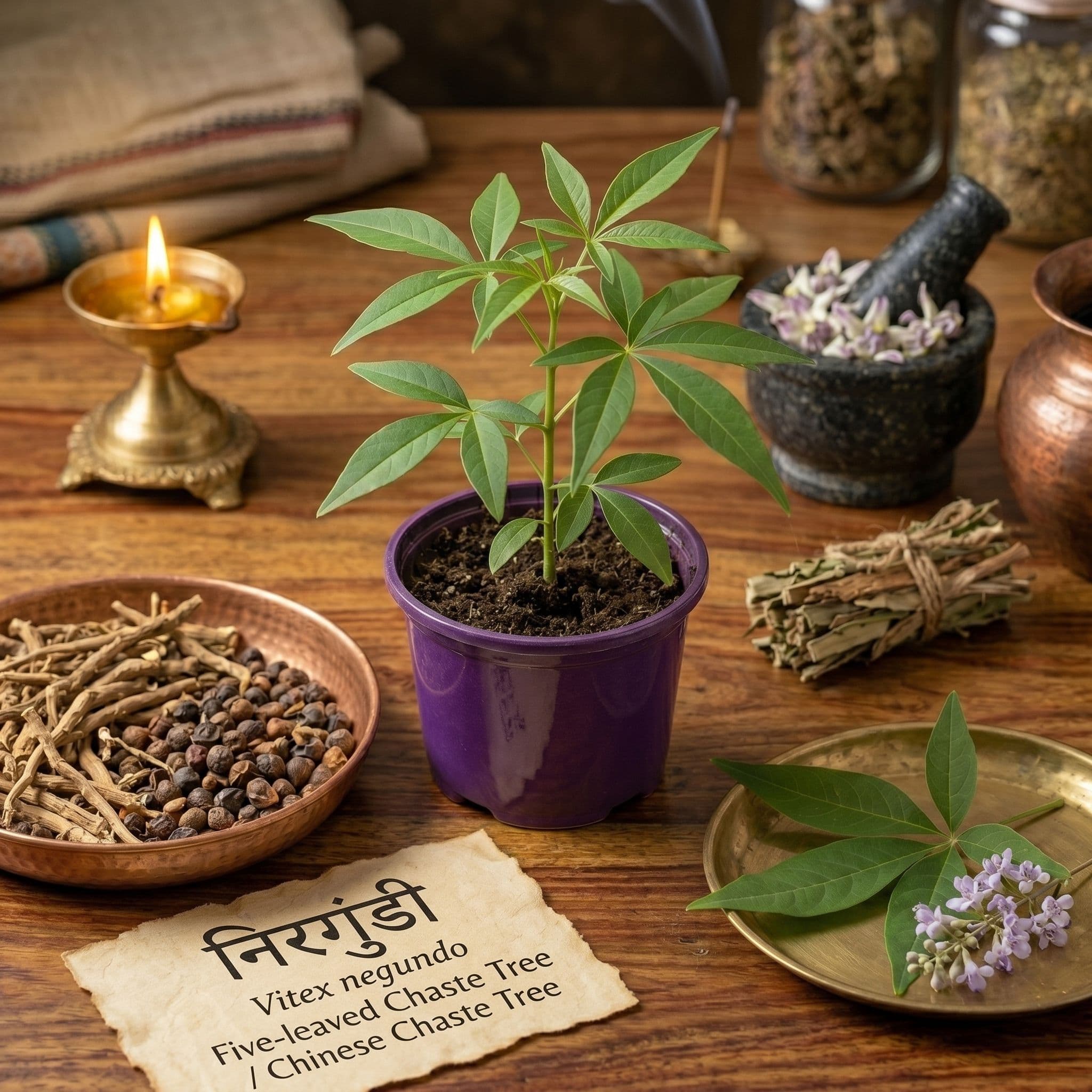
Nirgundi (Vitex negundo)
Botanical: Vitex negundo Linn.| English: Five-leaved Chaste Tree / Chinese Chaste Tree
Nirgundi (Vitex negundo Linn.), commonly known as the Five-leaved Chaste Tree, is a large aromatic shrub native to the Indian subcontinent and parts of tropical Asia. Revered in Ayurveda as a powerful Vata-shamaka (Vata-pacifying) herb, Nirgundi is a cornerstone remedy for joint disorders, respiratory ailments, and neurological conditions.
Its Tikta (bitter), Katu (pungent), and Kasaya (astringent) Rasa combined with Ushna (hot) Virya make it highly effective for addressing deep-seated inflammation, pain, and Kapha-related congestion. Modern phytochemical research validates its traditional uses through identified alkaloids, flavonoids, and essential oils that demonstrate analgesic, anti-inflammatory, and bronchodilatory actions.
Pure Nirgundi (Vitex negundo) Root Extract
Coming Soon

Top Health Benefits
1Analgesic & Anti-Inflammatory for Joint Health
Nirgundi acts as a potent Shothahara (anti-inflammatory) and Vatahara (nerve-calming) herb. Clinical trials on Vitex negundo leaf extracts demonstrated significant reduction in WOMAC scores for osteoarthritis patients (p < 0.01), confirming its classical use in Vatavyadhi (joint and musculoskeletal disorders), arthritis, and joint stiffness.
2Supports Respiratory Health
Nirgundi's Ushna (hot) Virya and Kaphahara (mucus-drying) actions help liquefy and expel excess Kapha from the respiratory tract. A randomized pilot study showed improved FEV1 and reduced bronchial hyper-reactivity after 4 weeks of Nirgundi seed powder supplementation (2 g/day), validating its traditional use for asthma, bronchitis, and chronic cough.
3Neurological & Mental Health Support
Classified as Medhya (brain-tonic) in Ayurvedic texts, Nirgundi supports nervous system health. Pre-clinical studies indicate that negundoside, one of its primary alkaloids, modulates serotonergic pathways and produces antidepressant-like effects, while vitexin demonstrates neuro-protective and anti-spasmodic activities beneficial for stress, anxiety, and neuromuscular disorders.
4Hormonal Regulation & Female Reproductive Health
Nirgundi is traditionally used as a Stree-dhatu-poshana (female reproductive tonic) to manage menstrual irregularities and menopausal symptoms. Small-scale clinical observations noted decreased FSH and LH levels after 8 weeks of Nirgundi fruit powder (5 g/day), supporting its phyto-estrogenic activity in regulating the female reproductive system.
5Antimicrobial & Wound Healing
The essential oil of Nirgundi, rich in linalool, alpha-pinene, and camphor, exhibits significant antibacterial and antifungal properties. Crushed leaf poultices have been traditionally applied for wound healing, skin infections, and to reduce local swelling, supported by its Tikshna (penetrating) quality that helps reach deep tissue layers.
6Rasayana (Rejuvenating) & Antioxidant Properties
Nirgundi is classified as a Rasayana (rejuvenating tonic) in Ayurvedic texts, nourishing body tissues and promoting longevity. Its flavonoid content — particularly quercetin and kaempferol — provides potent antioxidant protection against oxidative stress and free radical damage, slowing cellular aging and supporting overall vitality.
Ayurvedic Properties
How to Consume?
Nirgundi can be prepared and consumed in several traditional forms. Choose the preparation based on your specific health goals and always follow dosage guidelines provided by your Ayurvedic physician.
Fresh Leaf Juice (Swarasa)
Preparation: Wash fresh Nirgundi leaves thoroughly, grind into a smooth paste, and squeeze through a clean muslin cloth to extract pure juice.
Dosage: 10–20 ml daily.
Anupana (Vehicle): Mix with warm water or honey to balance the intense bitter-pungent flavor.
Timing: First thing in the morning on an empty stomach.
Dried Leaf or Fruit Powder (Churna)
Preparation: Grind shade-dried leaves or dried fruits into a fine, uniform powder.
Dosage: 3–6 g (divided doses) as directed by a practitioner.
Anupana (Vehicle): Stir into a cup of warm water.
Timing: Twice daily after meals.
Seed Powder
Dosage: 1–2 g (maximum) per day.
Anupana (Vehicle): Milk or ghee (to mitigate Pitta-aggravating effects).
Timing: Evening, before bedtime.
Nirgundi Taila (Medicated Oil) – External Use
Application: Apply 5–10 ml warm oil to affected joints, muscles, or scalp and massage gently.
Use: As needed for joint pain, neuralgia, and localized inflammation.
Note: Dosage must be individualized by a qualified Ayurvedic practitioner. Seek professional guidance especially if pregnant, lactating, or on prescription medications.
Botanical & Classical Identity
Etymology & Sanskrit Synonyms
Sanskrit: Nirgundi (निर्गुण्डी) — meaning "the one that protects the body from diseases"; also known as Sindhuvara, Simapriya, and Sephalika in classical texts.
Etymology: The name Nirgundi is derived from "Nir" (without) and "Gundi" (a group of diseases), reflecting the herb's broad disease-protective properties. It also means "the one that grows even when cut", indicating its vigorous regenerative habit.
Regional Names
Hindi: Nirgundi | Telugu: Nallavavilli | Kannada: Lakkigida | Malayalam: Indranee | Marathi: Nirgudi | Bengali: Nishinda | Tamil: Nochi | Gujarati: Nagod
Classical Categorization
Varga: Listed under Patrapaksha (leafy-vegetable group) in Bhavaprakasha Nighantu and also classified in Shangadhanya (herbs with sharp leaves). In Charaka Samhita, Nirgundi is included among the Dashamula (ten root formulation) herbs and is specifically mentioned for Vatavyadhi management.
Definitive Shloka (Bhavaprakasha Nighantu, 5.12.3)
Sanskrit: Nirgundi patram kantam varnam, gandham madhuram, vrksah ksinam
Translation: "The leaf of Nirgundi is dark and fragrant like sandalwood; the plant is modest in size. It pacifies Vata and Kapha, acting as both a nerve-calming and mucus-drying herb."
---
Phytochemical Profile (Modern Pharmacognosy)
The synergy of active phytochemicals in Vitex negundo underlies its dual central-peripheral analgesic and anti-asthmatic therapeutic potential:
1. Essential Oil (Leaves & Bark)
Key Constituents: Linalool, alpha-pinene, camphor, sabinene, and beta-caryophyllene.
Action: Provides primary anti-inflammatory activity by inhibiting prostaglandin synthesis. Camphor contributes to analgesic and counter-irritant effects when applied topically in Nirgundi Taila.
2. Alkaloids
Key Constituents: Negundoside and Vitexin.
Action: Negundoside exhibits neuro-protective activity against oxidative neuronal damage and modulates serotonergic pathways. Vitexin demonstrates anti-spasmodic activity useful in bronchial spasms and muscular cramps.
3. Flavonoids
Key Constituents: Quercetin, Kaempferol, Luteolin, and Artemetin.
Action: Potent antioxidants that scavenge free radicals. Quercetin and Kaempferol act as bronchodilators by relaxing airway smooth muscle — supporting the herb's use in asthma and allergic rhinitis.
4. Triterpenoids
Key Constituents: beta-Amyrinol and Ursolic acid.
Action: Demonstrate significant analgesic activity in animal models (writhing test and hot plate test). Ursolic acid also contributes to hepatoprotective and anti-inflammatory effects.
---
Classical Formulations & Use Cases
The following classical Ayurvedic formulations containing Nirgundi have been documented in authoritative texts:
1. Nirgundi Taila (Medicated Oil)
Reference: Dashamula Taila — Charaka Samhita, Rasayana Adhyaya.
Primary Use: Vata-related pain, sciatica (Grudhrasi), neuralgia (Vatashula), and paralysis (Pakshaghata).
Application: Warm oil massage (Abhyanga) over affected area; also used as medicated enema (Basti) base in Panchakarma.
2. Trivikrama Rasa
Reference: Rasaratnakara.
Primary Use: Arthritis (Sandhivata), joint stiffness, and inflammatory joint conditions.
Application: Oral formulation taken with warm water or Nirgundi decoction as Anupana.
3. Mahavata Vidhvansana Rasa
Reference: Yogaratnakara.
Primary Use: Chronic backache, intervertebral disc degeneration (Katishula), and degenerative Vata disorders.
Application: Taken internally with ghee or warm water under physician supervision.
4. Swarasa (Fresh Leaf Juice Preparation)
Reference: Siddha and classical Ayurvedic practice.
Primary Use: Acute respiratory infections, Kasa (cough), Shvasa (breathlessness/asthma), and febrile conditions.
Application: Fresh juice consumed orally or used as nasal drops (Nasya) for sinus congestion.
Typical External Applications: Crushed leaf poultice (Patra Pinda Sweda) applied warm over swollen, painful joints; leaf smoke fumigation for insect repellency and respiratory relief.
---
Conclusion
Nirgundi (Vitex negundo) is a multi-dimensional Ayurvedic herb whose Vata-hara, Kapha-ghna, and Rasayana qualities make it a cornerstone for joint health, respiratory wellness, and neurological balance. Modern phytochemical investigations validate its traditional uses, uncovering alkaloids, flavonoids, and essential oils that confer analgesic, anti-inflammatory, and bronchodilatory actions. When administered according to classical dosage and Anupana recommendations, Nirgundi offers a safe, evidence-based option for integrative management of chronic pain and respiratory disorders while preserving the tridoshic equilibrium central to Ayurvedic philosophy.
Side Effects & Cautions
Nirgundi is generally well-tolerated when used correctly. However, the following cautions must be observed:
Pregnancy & Lactation: Strictly avoid during pregnancy and breastfeeding. Nirgundi's phyto-estrogenic compounds can stimulate the uterus and alter delicate hormonal profiles, posing risk to the fetus or nursing infant.
Drug Interactions: May interact with anticoagulants (increased bleeding risk) and antihypertensives (additive heating effect due to Ushna potency). May interfere with oral contraceptives or hormone replacement therapy (HRT). Always inform your physician about all medications.
Side Effects from Overdosage: Due to its naturally Ushna (heating) and Katu (pungent) nature, excess consumption without proper cooling Anupana (vehicle) may cause mild gastric irritation, heartburn, or a hot/burning sensation in the stomach.
Pitta Precaution: Not recommended for individuals with a Pitta-dominant constitution (Prakriti) without a cooling vehicle such as milk or ghee to balance the herb's heating quality.
Topical Use: When applying Nirgundi Taila externally, a patch test is recommended for individuals with hypersensitive skin.
Safety Shloka: "When administered without a cooling vehicle, Nirgundi may aggravate Pitta, leading to burning sensation and hyperacidity." — Bhavaprakasha Nighantu, 6.4.1
Frequently Asked Questions
Can I take Nirgundi daily?▼
Yes, Nirgundi can be taken daily. The standard dose is up to 6 g of dried leaf powder per day, ideally for 4–6 weeks under professional supervision. Prolonged use requires periodic breaks to prevent tolerance build-up. Always consult a qualified Ayurvedic practitioner for personalized dosage and duration guidance.
How quickly does Nirgundi relieve joint pain?▼
Most users report noticeable improvement within 7–10 days of regular use. For best results with joint pain, use Nirgundi Taila for daily oil massage combined with internal consumption of leaf powder or swarasa. Consistent use for 4–6 weeks typically yields significant results, though this varies with the severity of the condition.
Is Nirgundi safe for asthma patients on inhaled steroids?▼
Nirgundi is generally considered safe for asthma patients as it acts as a natural Kapha-ghna (mucus-clearing) agent. However, patients on inhaled steroids or bronchodilators should monitor for any additive bronchodilatory effect. Always consult your pulmonologist and Ayurvedic physician before combining Nirgundi with conventional asthma medications.
Does Nirgundi interact with hormonal contraceptives?▼
Yes, there is a potential interaction. Nirgundi contains phyto-estrogenic compounds that may alter menstrual cycles and potentially interfere with the efficacy of oral contraceptives or hormone replacement therapy. Women on hormonal contraceptives should seek a medical review before starting Nirgundi, and report any changes in menstrual pattern to their healthcare provider.
Can children use Nirgundi?▼
Yes, Nirgundi can be used for children in reduced doses. The pediatric dose is typically half the adult dose — approximately 1–2 g of leaf powder or 5–10 ml of swarasa. However, this must only be administered under qualified Ayurvedic guidance. For topical use (Nirgundi Taila), dilute the oil before applying on children's skin.
What is the difference between Vitex negundo and Vitex agnus-castus?▼
Both belong to the Vitex genus but differ in their primary therapeutic uses. Vitex negundo (Nirgundi) is native to Asia and is primarily used in Ayurveda for analgesic, anti-inflammatory, and respiratory health benefits, particularly for joint disorders and Vatavyadhi. Vitex agnus-castus (Chaste Tree), common in Western herbalism, is primarily known for hormonal support, especially for PMS and menopausal symptoms. They have distinct phytochemical profiles and should not be used interchangeably.
Scientific References
1. Ministry of AYUSH. The Ayurvedic Pharmacopoeia of India, Part I, Volume II. Government of India. Section 64, pp. 145–146.
2. Global Herbal Research Database. Nirgundi (Vitex negundo): Benefits, Uses, Side Effects & More. 2023. [Online Resource].
3. ResearchGate. An Overview of Nirgundi (Vitex negundo). 2022. Available from: https://www.researchgate.net
4. Zenodo. Vitex negundo Linn (Nirgundi): Journey from Past to Future. 2021. Available from: https://zenodo.org
5. Bhavaprakasha Nighantu, 5.12.3 – Classical description of Nirgundi's properties and actions. Chaukhambha Krishnadas Academy, Varanasi.
6. VedClub Botanical Archive. Vitex negundo: Ayurvedic Uses, Benefits, Botany. 2024. [Internal Resource].
Article Reviewed By

Syed Aman Hussain
BAMS, MD
Dr. Syed Aman Hussain is a dedicated Ayurvedic physician specializing in the ancient science of detoxification and rejuvenation. An alumnus of the highly esteemed Ayurvedic and Unani Tibbia College, Government of NCT of Delhi, he holds a degree in Bachelor of Ayurvedic Medicine and Surgery (BAMS).