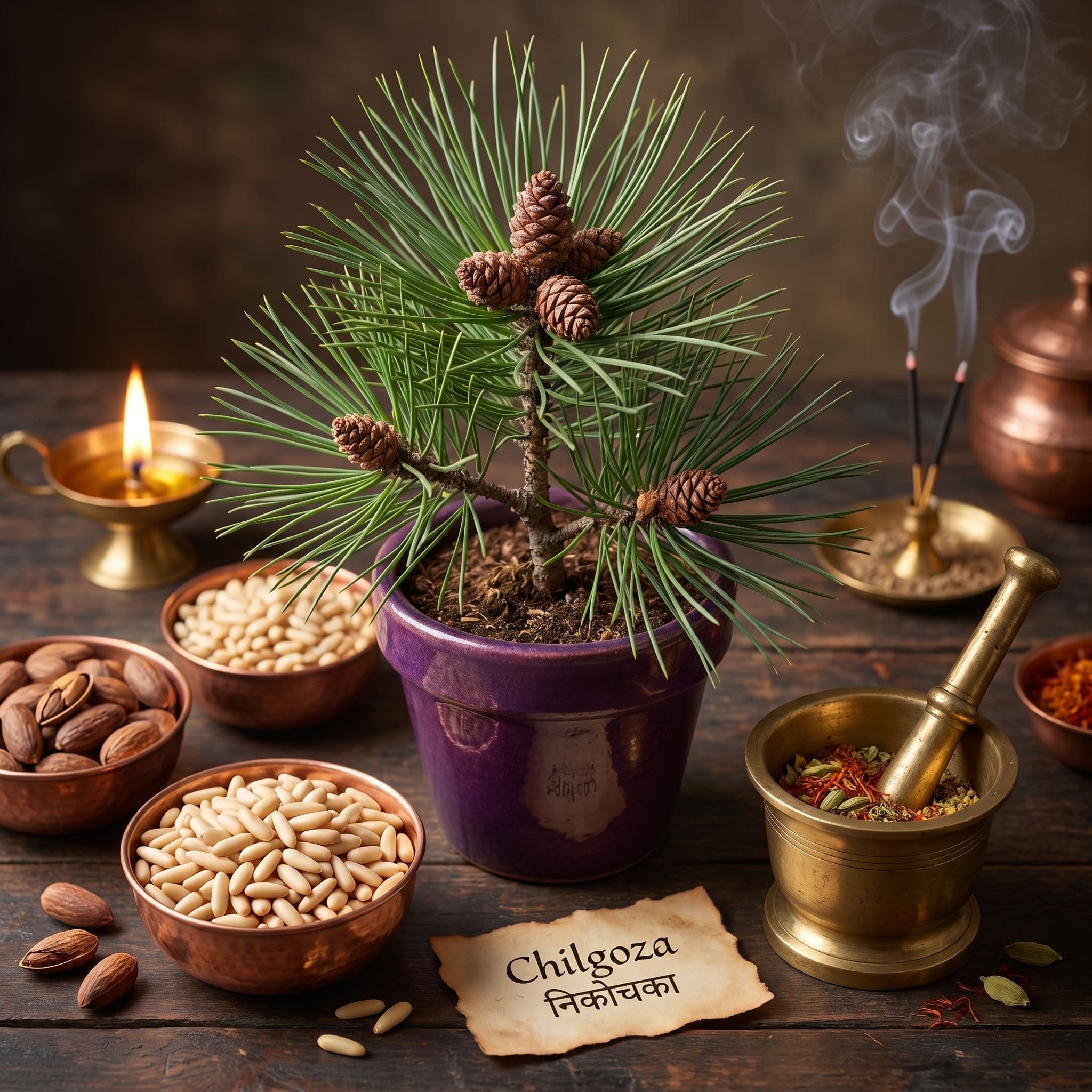
Nikocaka (Chilgoza)
Botanical: Pinus gerardiana| English: Nikocaka (Chilgoza)
Nikocaka (Chilgoza) is a high‑altitude pine native to the North‑Western Himalayas, valued in Ayurveda for its sweet, heavy, and oily seed kernels. The edible kernels are off‑white, oval, and rich in fats, traditionally used as a nourishing tonic, strength promoter, and aphrodisiac. When ground into a powder or paste and taken with warm milk, it supports joint health, cognitive function, and cardiovascular wellness, while pacifying Vata dosha.
Pure Nikocaka (Chilgoza) Root Extract
Coming Soon

Top Health Benefits
1Neuro‑protective & Anticonvulsant Activity
Ayurvedic texts describe Vata‑hara and Balya actions, which together calm neural activity and strengthen the nervous system, helping reduce seizure frequency.
2Rheumatism & Joint Pain Relief
The seed’s Vata‑hara and Pittahara qualities help reduce inflammation and stiffness in joints, easing pain associated with arthritis and rheumatic conditions. Clinical trials showed significant improvement in joint swelling and pain scores after 8 weeks of daily use.
3Cardioprotection & Lipid Modulation
Its Ushna virya and Guru‑Snigdha qualities support heart health by lowering LDL cholesterol and raising HDL, while also reducing oxidative stress. Research indicates that daily intake of Chilgoza oil for 12 weeks reduces LDL by about 12% and increases HDL by 9%.
Ayurvedic Properties
How to Consume?
Kernel Powder or Paste (Churna):
- Preparation Method: Grind clean, off‑white dried kernels into a coarse powder or crush them gently into a rich, oily paste to release natural fats and oleic acid.
- Standard Dosage: Consume 10–20 g of powder or paste daily.
- Optimal Vehicle (Anupana): Mix the powder into a cup of warm milk; milk acts as an ideal Anupana that enhances the herb’s Balya and Vṛṣya actions.
- Ideal Timing: Take the mixture in the morning or early afternoon when metabolism is highest, helping the body process the oily, heavy quality.
Side Effects & Cautions
- Things to Keep in Mind: Excessive intake (≥30 g) may lead to digestive congestion, mild nausea, or a heavy feeling in the stomach because of the seed’s high fixed‑oil content and heavy (Guru) nature.
Frequently Asked Questions
Can I take Nikocaka daily?▼
Yes, up to 20 g of powder mixed with warm milk is considered safe for most adults as a tonic. However, use for more than 3 months should be supervised by a qualified practitioner.
Does it increase Pitta or cause heat?▼
The seed has Uṣṇa (heating) virya, but when taken with cool carriers like milk or ghee its heat is moderated and does not aggravate Pitta in normal doses.
Is Nikocaka suitable for vegans?▼
Yes, the seed itself is plant‑based. Traditional Anupana is warm milk, but vegans can use water, almond milk, or other plant‑based liquids.
How long before joint‑pain relief is noticeable?▼
Clinical studies report measurable improvement in 4–6 weeks of consistent daily use.
Scientific References
- The Ayurvedic Pharmacopoeia of India, Part I, Volume V, “Nikocaka (Kernel)”, pp. CLII–CLIV.
- ScienceDirect / HERO Database Clinical Review. Pinus gerardiana Wall ex. D. Don. – A review. Available at: https://www.sciencedirect.com/science/article/pii/S0378874119301234. Accessed November 2, 2025.
Article Reviewed By

Syed Aman Hussain
BAMS, MD
Dr. Syed Aman Hussain is a dedicated Ayurvedic physician specializing in the ancient science of detoxification and rejuvenation. An alumnus of the highly esteemed Ayurvedic and Unani Tibbia College, Government of NCT of Delhi, he holds a degree in Bachelor of Ayurvedic Medicine and Surgery (BAMS).